I tend to think the political unrest we are experiencing in the U.S. is unique in the global realm and our trials and tribulations will change the world as we know it. I need to remember that we are not the first – or the last – to live in a time of national uncertainty. In my mind, Spain has one of the most important lesson to teach us. I write to you today from Huelva, Spain, a country and region I love. I am enthusiastic about the nation’s geography, economy, history, culture, and, most of all the Spanish people. It is their recent political history (1939-1975) that delivers what I believe to be one of the most important lessons on contemporary national transformations. The time of Franco.
It has not been long since the dictator who led a long and highly successful war against democracy, General Francisco Franco, passed. According to many historians, Franco’s nearly four-decade grip on Spain (1939–1975) rested on several interlocking mechanisms that analysts examined from political, institutional, economic, to geopolitical dimensions. My interest is on the health of a nation’s psyche. I am curious. Are there similarities between the years of Francisco Franco and what we, in the U.S. are experiencing today?
The rule of Franco had significant similarities to the war on democracy led by Hitler and Mussolini. Franco’s control of media and state education fostered compliance through fear. While there were those who were grateful for improvement of living standards for the few, the majority feared the Franco regime. Lessons in history are hard learned, and Franco’s legacy of terror influenced the collective Spanish psyche with a determination never again to undergo such civil conflict or to suffer another dictatorship.
Make no mistake, Franco had support particularly in later years. He was popular in many circles and not due to fear or repression. Followers, who for reasons of wealth, religious or ideological belief sympathized with his use of military force and rule. These were the few.
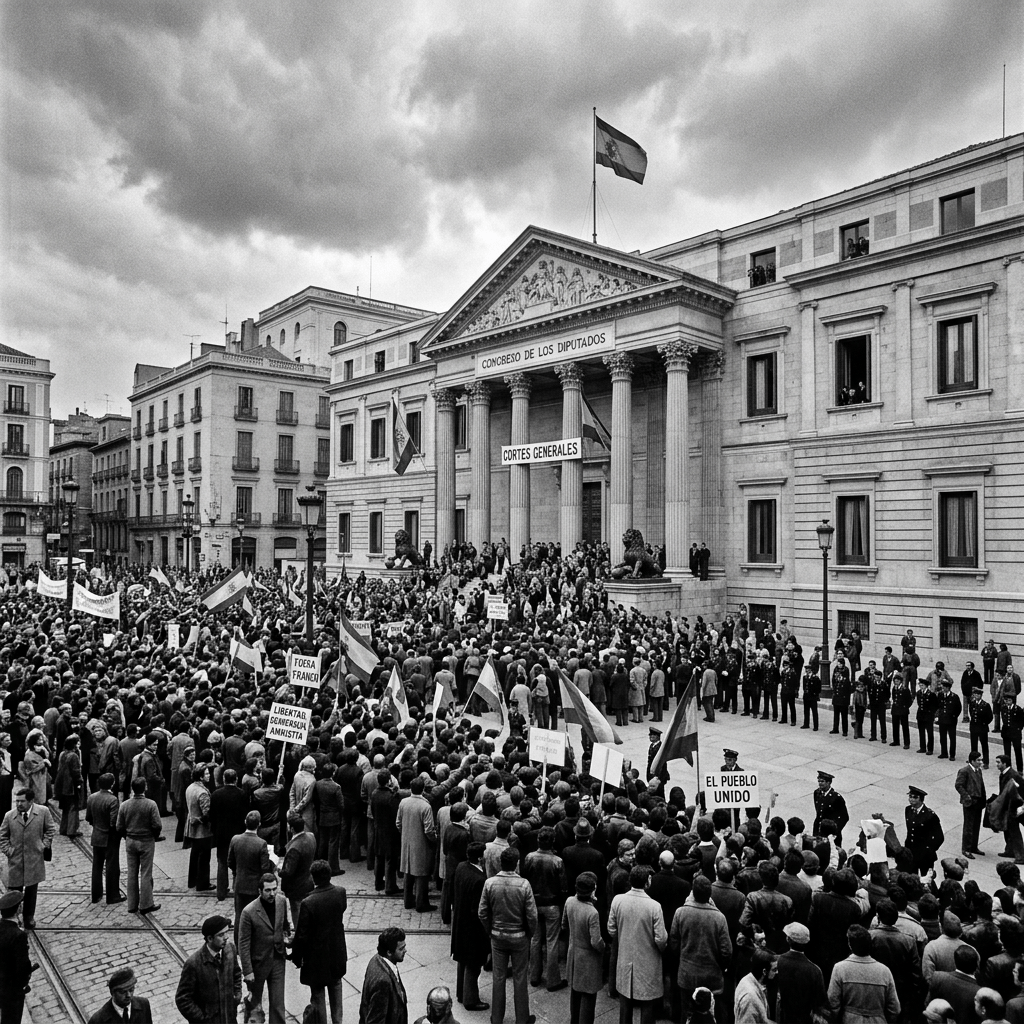
Perhaps the most important lesson from history is that the mechanisms that kept Franco in power did not survive after his death. Change came quickly. While Franco envisioned his legacy to continue, naming Juan Carlos I as heir to his rule, the plan was not successful. Immediately after Franco’s death, Juan Carlos I began institutional reforms that would lead the country from a dictatorship to a parliamentary monarchy. In the U.S. we have executive, legislative and judiciary governance. Spain has a monarchy and it was Juan Carlos I who successfully transitioned the country to a democracy after the death of Franco in 1975. The Franco regime that was built to perpetuate itself dissolved within three years of Franco’s death.
The lessons from Spain bring hope.
- Aróstegui, Julio. “The Memory of the Civil War and of Francoism in Democratic Spain.” (2002).
- Encarnación, O. G. (2014). Democracy without justice in Spain: The politics of forgetting. University of Pennsylvania Press.
- Humlebæk, C. (2010). Party Attitudes towards the Authoritarian Past in Spanish Democracy. South European Society and Politics, 15(3), 413–428. https://doi.org/10.1080/13608746.2010.513602
 Martha Wilcoxson, EdD, Colorado NDR

Leave a Reply